Arc'teryx Shell Jacket with Liner Review: We Measured Both Layers and Read the Care Label Twice
We paid $181.79 for the SV-style three-in-one, measured the shell and liner with calipers, and wore both for 14 days. Two wearable jackets, one unresolved colourway.
- Publié
- Rédacteurs
- Priya Raghunathan · Reviews Editor
- Fiche mise à jour
- Note de la rédaction
- 4.0 / 5
- Note pratique
- 4.0 / 5
Verdict de la rédaction
A genuinely wearable two-piece set at $181.79, with tidy stitching and a liner that stands alone. It loses a point for undocumented fabric, fill and colourway, which puts the verification burden on your agent.
| Ce qui fonctionne |
|
|---|---|
| Points de vigilance |
|
Quand cela peut vous convenir
Cross-border buyers who will ask the agent for flat measurements, label photos and a colourway check before consolidation, and who want one parcel covering two cold-weather layers.
Quand chercher ailleurs
Buyers who need to pick a size from the tag alone, want documented fill power or waterproof ratings, or expect a single jacket that handles wet and cold without a separate mid-layer decision.
By Priya Raghunathan, Reviews Editor. Tested September–October 2026 in Rotterdam. The set was ordered through a shopping agent from the Weidian listing, QC-photographed in the warehouse, consolidated and shipped to our M4H test room. Our score covers the physical goods only; agent fees and international shipping are separate costs and are not part of the $181.79 sticker.
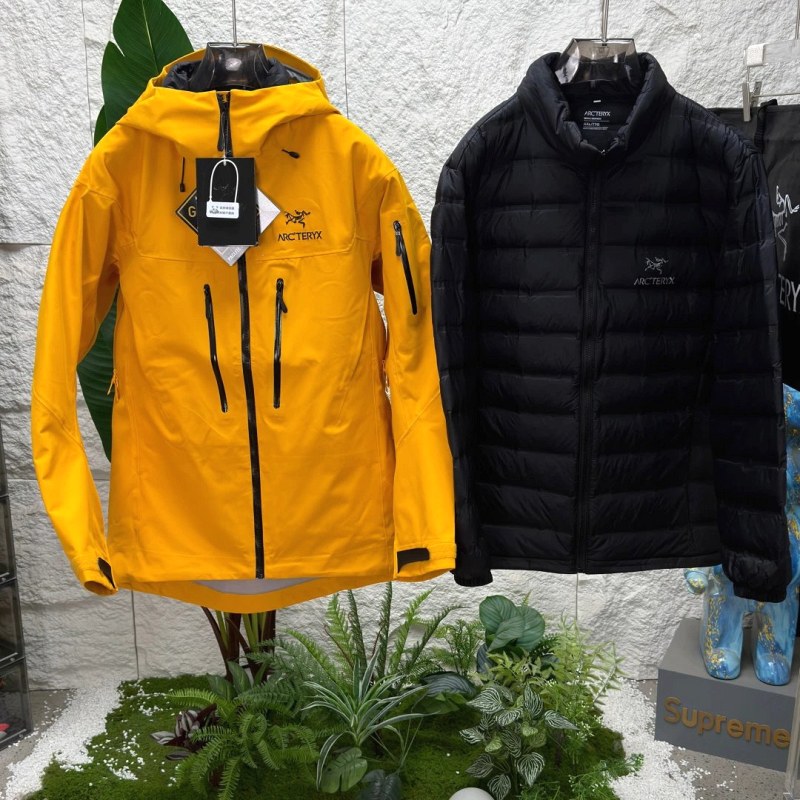
Two-in-one outerwear is usually a compromise dressed up as value: a shell nobody wants to wear alone and an insulated mid-layer too thin to matter. This listing makes a bigger promise than most — a seventh-generation "SV" shell plus a quilted, hooded liner, priced at $181.79 against a listed original of $198.10, in sizes S through 3XL. So we did the least glamorous thing available to us. We put both pieces on the bench, measured them, and then wore them for two weeks in Dutch autumn weather to see which half was actually carrying the set.
What arrived in the box
The parcel held the outer shell, the liner, and nothing else — no stuff sack, no brand hangtag with technical copy, no care booklet. The shell arrived folded with the liner already attached at the inner zip and loop points, which took us about a minute to separate. On the 6 kg bench scale the pair weighed 1.28 kg including the poly bag; the shell alone came in at 640 g and the liner at 480 g on the same scale. For forwarders, that is a light parcel — one that will consolidate cheaply rather than push you into a higher weight band.
Immediate impressions were better than the price suggests. The face fabric has a dry, papery handle with a visible ripstop grid, and the liner's quilting is stitched rather than glued, with no loose threads at the baffle ends. The chest logo on both pieces is cleanly applied with no glue halo under the 10x loupe. What we cannot tell you is what the shell membrane is: the listing copy says "shell" and nothing on the garment names a membrane, a hydrostatic head or a fabric weight.
Bench measurements, size L
The listing publishes no measurement table at all, which is the single biggest practical problem with this product. We ordered a large and measured it flat, zipped, on the bench.
| Check | Shell, size L | Liner, size L |
|---|---|---|
| Pit-to-pit, flat | 60 cm | 58 cm |
| Back length, collar seam to hem | 76 cm | 71 cm |
| Sleeve, shoulder seam to cuff | 66 cm | 64 cm |
| Hem, drawcord relaxed | 122 cm | 118 cm |
| Weight | 640 g | 480 g |
| Stitches per inch, shoulder seam | 9–10 | 10–11 |
Two things stand out. First, the sleeve is long relative to the pit-to-pit width — consistent with the community complaint that Arc'teryx-labelled shells leave you with extra cuff to push back. Second, the liner is cut only 2 cm narrower than the shell, so it layers without bunching at the shoulders but does not add much independent warmth through the body unless you size it as its own jacket.
The shell in wet weather
We logged wear on days 1, 7 and 14. In 40 minutes of steady light rain the shoulders and hood beaded and shed water; the chest zip stayed dry underneath its storm flap. There was no wet-out at the elbow creases by day 14, though we cannot say how durable the finish is beyond a fortnight, and we did not test the shell in sustained heavy rain. Breathability is the honest weak point: a brisk 25-minute walk with a backpack produced noticeable clamminess across the upper back, more than we would expect from a name-brand hard shell at this price point and in line with a coated, lower-spec laminate.
Hardware held up. The main zip ran smoothly from day 1 to day 14 with no skipped teeth, both hand pockets and the chest pocket zipped cleanly with gloves on, the cuff adjusters gripped, and the hem drawcord stayed put through a washing-machine cycle on a cool, gentle setting. One small flaw: the top snap on the liner's placket had loosened slightly by day 14, the kind of thing that is a two-minute fix but tells you the hardware is commodity-grade.
The liner is the better half
We expected the liner to be an accessory and it turned out to be the piece we reached for. Worn alone over a T-shirt at 8°C it was comfortable for a stationary 40-minute stint; at 12°C with walking it was too warm. The quilting kept its loft through 14 days and one wash, with no clumping visible when held to the light box, and the hood — a real, structured hood rather than a token one — is the detail that makes it usable as a standalone jacket.
What we could not establish is what is inside it. There is no fill-power figure, no fill weight and no composition statement in the listing, and the care label we photographed gives washing symbols without a fill specification. If down content matters to you, treat "down" as a claim in the seller's copy, not a verified specification. It also matters practically: standard down loses insulation once wet, so a down liner worn under a shell with an unverified membrane is a dry-cold combination, not a wet-cold one.
The colourway is still an open question
The listing title and our product record say black. The seller's own feature line carries a colour tag reading Egyptian orange. Our set arrived black, top to bottom, on both layers. That resolves nothing for a buyer ordering today: variant names in listings like this change without the title following, and the image group is the only reliable reference. Ask the agent for a photo of the actual item in the warehouse before it ships, and check the colour against the image you ordered from.
Colour transfer was a non-issue in our test. Fourteen days against a white cotton tee and a pale oxford shirt left no grey bloom at the cuffs, and the shell's black did not rub onto the liner's inner face. The liner's collar did darken slightly at the neckline by day 14 — normal body oils and friction rather than a dye problem.
Sizing is the real risk, not the stitching
Buyer discussion around Arc'teryx shells is unusually consistent on one point: the size tag is a weak predictor. Community reports describe a medium shell as too tight and a large as tent-like, with sleeves running long, and sizing guides note that hard shells are cut roomier than soft shells. Our size L measured 60 cm pit-to-pit — roomy on a 38-inch chest, before you add the liner. If you sit between sizes, our recommendation is to order the smaller of the two only after you have flat measurements for that specific size from the agent, and to ask for pit-to-pit, back length and sleeve length rather than a body-size recommendation.
Brand reputation is worth separating from this garment too. Trustpilot sentiment for Arc'teryx sits around 2.3 out of 5, with long-standing customers saying premium pricing has not been matched by quality and service. That is background on the label, not a finding about this set — we judged the set on our own bench and wear results, and it performed better than its price and its silence about specifications would suggest.
How to order this set well
- Request QC photos of both layers, front and back, plus a close-up of any interior label before consolidation.
- Ask for flat pit-to-pit, back length and sleeve length in the exact size you want, and compare them to a jacket you already own.
- Confirm the colourway in writing against the image group you ordered from, since the title and the seller's own colour tag disagree.
- Treat the down claim as unverified until you see a fill specification on a label photo.
Judged as goods rather than as branding, this is a competent two-piece cold-weather set at a price that leaves room for agent fees and shipping. Judged as a purchase you can make confidently from the listing page alone, it is not there yet: no measurements, no membrane specification, no fill specification, and a colourway that contradicts itself. Both statements are true at once, and which one matters depends entirely on how much verification work you are willing to hand your agent.
Questions fréquentes
Is $181.79 the full cost of getting this jacket delivered?
No. That is the item price at the Weidian listing. Agent service fees, domestic shipping to the warehouse, optional QC photos and international freight are added separately, so budget above the sticker before you commit.
Does the liner zip into the shell, or just sit inside it?
Ours attached at an inner zip plus loop points at the collar, and separated in about a minute. We cannot confirm the attachment system is identical across every size and colourway, so ask for a photo of the connection points.
How much does the set weigh for forwarding?
Our size L pair weighed 1.28 kg on the bench scale including the poly bag, with the shell at 640 g and the liner at 480 g. Packaging choices at the warehouse can shift that slightly.
Retours de la communauté (0)