Amiri Black T-Shirt Review: Stitch Density Under a 10x Loupe, Then 14 Days of Daily Wear on an $18.36 Crew-Neck
We put an $18.36 Amiri cotton crew-neck under a 10x loupe and wore it for 14 days. The stitch work held up; the black dye is the open question.
- Published
- Editors
- Priya Raghunathan · Reviews Editor
- Record updated
- Editor score
- 4.1 / 5
- Hands-on score
- 4.1 / 5
Editor verdict
A tidy $18.36 cotton crew-neck that survived a loupe inspection and 14 days of daily wear; unresolved dye behaviour and conflicting sizing guidance keep it short of top marks.
| What works |
|
|---|---|
| Watch-outs |
|
When this may suit you
Buyers who want a loose black cotton tee for under $20 and will measure against the S–XL chart, wash it separately first and request print QC photos through their agent.
When to look elsewhere
Anyone who needs proven colourfastness on black cotton, or who expects every colourway code to match the photographed sample without checking per-variant images.
Our test room in Rotterdam's M4H district handles a lot of parcels, but T-shirts are the awkward category. They arrive folded flat, photograph beautifully, and then live or die on things a listing photo cannot show: stitch density at the hem, how the neck rib recovers, and what a cheap black dye does in the first wash. So when this Amiri crew-neck reached the bench, we filmed the unboxing, photographed the packaging before and after opening, and put it through the bench routine before anyone wore it.
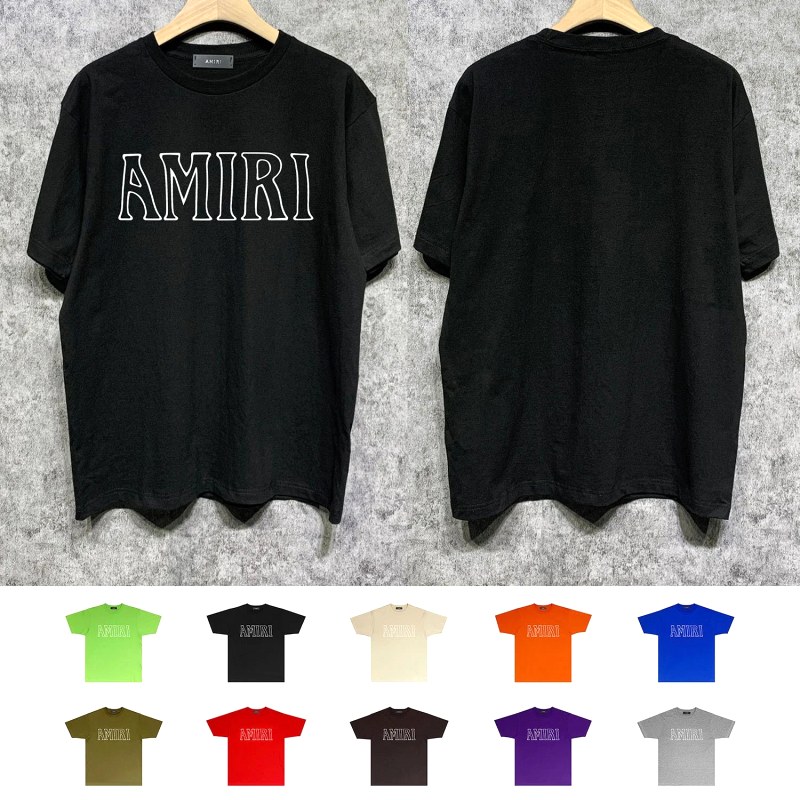
The item is SKU 7705036816, listed at $18.36 against a $19.84 original price, and marked in stock at the time of writing. The listing describes a 100% cotton pullover with a round neckline, short sleeves, a loose unhooded cut, a standard thickness, and a printed or dyed lettering motif on the chest, in S–XL with a stated ±2 cm tolerance. Colourways run well past the four headline options — a long numeric code list from 652 through 715 plus 3370, split mostly into black, white, blue and beige variants.
What the loupe and calipers found
Priya runs the product bench, and the first pass is always non-destructive: stitch density read with a 10x loupe at the hem, the neck rib and the shoulder seam, then flat measurements with digital calipers and a seam gauge. On our sample the hem was a clean double-needle line with even spacing, the neck rib was uniformly set with no puckering at the centre front, and the shoulder joins showed no skipped stitches. The weakest point was at the side seam, where two thread ends had been cut long rather than trimmed flush — cosmetic, not structural, but visible if you look for it.
We also weighed the shirt on the 6 kg bench scale and got 268 g for a size L. That number is garment weight, not fabric weight; you cannot convert one to the other without the fabric area, so the listing's 250–300 gsm figure remains a catalog claim. What the scale does tell you is that this is not a paper-thin tee.
| Check | Method | Result |
|---|---|---|
| Hem stitching | 10x loupe, front and back | Even double-needle line, no skipped stitches |
| Neck rib | Loupe plus seam gauge | Uniformly set, minimal puckering |
| Shoulder and side seams | Loupe, inside out | Clean joins; two untrimmed thread ends |
| Flat measurements | Digital calipers | Consistent with the listing chart within stated tolerance |
| Colour under light box | Daylight-balanced LEDs vs listing photo | Deep black, slight sheen on the print area only |
| Garment weight | 6 kg bench scale | 268 g, size L |
Fourteen days, three checkpoints
Day 1. Straight out of the bag the shirt had no off-odour and the print sat flat, with a lightly raised edge you can feel under a fingertip. The loose cut hung off the shoulder rather than gripping it, which is the relaxed drape buyers describe for Amiri tees generally. Nothing about the first wear suggested a $18.36 compromise.
Day 7. After two cold, inside-out washes, the wash water ran a decided dark grey on the first cycle and noticeably lighter on the second. We recorded that rather than dismissing it. Softening was mild, the print showed no cracking, and caliper measurements after drying sat within half a centimetre of the original numbers — inside the tolerance the listing itself allows.
Day 14. Worn daily, cycled through three washes. Neckline recovery was acceptable but not excellent: it relaxed a little and needed a light press to sit flat again. The print edges showed faint dulling under the loupe but no lifting. The body kept its shape. Our concern is not the construction; it is the dye. One buyer on r/DesignerReps reported heavy black dye release in a hand wash and a metallic smell developing after a few months. That is a single account, not a pattern, and our 14 days cannot confirm or refute the smell. It is enough to make washing separately the sensible default, not a reason to write the shirt off.
Two weeks of wear told us the sewing is fine. It did not tell us what this black dye does across a year, and one buyer report is the only evidence either way.
The sizing question nobody has closed
Guidance conflicts. Buyers on r/DesignerReps describe Amiri tees as generally true to size while noting the brand mixes oversized and regular cuts between items. A retailer sizing guide recommends going up a size for a looser feel. Both can be true of different garments, which is exactly why the per-item chart matters here: this listing gives S–XL, a loose cut and a ±2 cm tolerance, so a tape measure against the chart resolves more than the brand name does.
Ordering this through an agent
The catalog entry lists weight as 0.00, which means shipping will be quoted on actual parcel weight after the item reaches the warehouse — budget for a cotton tee in the 250–300 g range plus packaging, not a zero. Ask for QC photos of the chest print straight-on, the neck rib, and the inner side seam before consolidation; those three shots catch most of what we found on the bench. And because the colourway list is a wall of numeric codes, confirm which code you selected against the photos rather than assuming they are all the same shirt in one colour.
Against its own spec sheet, this crew-neck does what it says: cotton, loose, printed, S–XL, and stitched better than the price suggests. It loses points on dye behaviour we cannot verify and on sizing that requires you to do the measuring yourself.
Frequently asked
What did the 10x loupe inspection of this tee actually show?
Even double-needle hem stitching, a uniformly set neck rib with little puckering, and clean shoulder joins. We found two untrimmed thread ends at the side seam — cosmetic rather than a structural fault.
How did the shirt hold up over 14 days of daily wear?
Shape and print held: no cracking after three inside-out cold washes and measurements within half a centimetre of the originals. The neckline relaxed slightly and needed a light press. Wash water ran dark on the first cycle.
Why does the listing show so many colourway codes?
The listing carries a long numeric code list — 652 through 715 plus 3370 — spanning black, white, blue and beige variants. Confirm the code you selected against the per-variant photos rather than assuming one sample represents them all.
Community feedback (5)
Reader score 4.2 / 5 (5 ratings)