Arc'teryx Blue Shell Jacket Review: 14 Days of Commuting in a $104 Softshell
We paid $104.48 for the blue Arc'teryx-styled shell and wore it for 14 winter commute days. It is a fleece-lined softshell, not the hardshell the title promises, and the size chart needs checking.
- Published
- Editors
- Priya Raghunathan · Reviews Editor
- Record updated
- Editor score
- 4.0 / 5
- Hands-on score
- 4.0 / 5
Editor verdict
A well-made fleece-lined softshell for drizzle and shoulder seasons, let down by a "waterproof hard-shell" title and a chest chart that reads large. At $104.48 it earns its place — confirm the size row first.
| What works |
|
|---|---|
| Watch-outs |
|
When this may suit you
Commuters and casual crag users on slim or average builds who want fleece-lined warmth and light weather protection at around $100, and who will check measurements before ordering.
When to look elsewhere
Anyone needing a genuinely waterproof, seam-sealed shell for sustained rain, buyers who carry weight at the midsection, and bareheaded wearers who dislike a roomy hood.
The listing calls this a waterproof hard-shell. The product text underneath it describes a Gamma MX-style softshell with a thin fleece backer. Those two things are not the same garment, and after two weeks of daily wear we can tell you which one actually turned up in the box.
What we ordered and what it cost
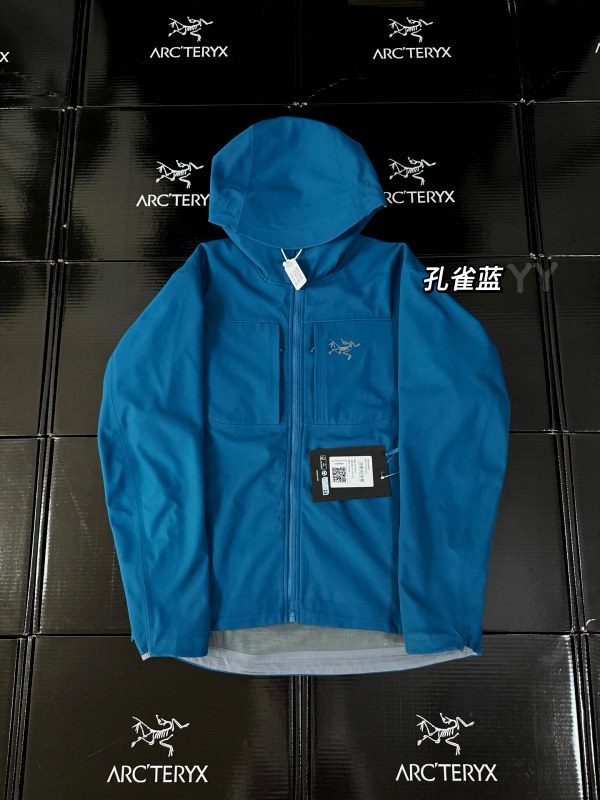
We placed the order through a shopping agent on the Weidian listing (SKU 7705058876) at $104.48, marked down from $110.08. The parcel reached our Rotterdam test room without retail packaging — no box, no hangtag sleeve, no warranty card — which is normal for this lane and worth knowing before you buy. The jacket itself arrived folded in a plain poly bag with the Arc'teryx chest logo, a branded tag on the main zipper and a visible interior lining, matching the listing photographs.
The blue is slightly deeper and less saturated than the listing image. Under our daylight-balanced light box the difference sits at roughly one shade — enough to notice side by side, not enough to change how it coordinates.
Bench numbers against the chart
We ordered size M and measured the sample with digital calipers and a seam gauge, then checked stitch density with a 10x loupe. Everything in the table below comes off that single jacket.
| Check (size M sample) | Our measurement | Listing claim |
|---|---|---|
| Chest, flat pit-to-pit | 55.5 cm (about 111 cm around) | 118 cm chest |
| Body length, collar seam to hem | 72.0 cm | 72 cm |
| Shoulder width | 47.5 cm | 47 cm |
| Sleeve length | 63.5 cm | 63 cm |
| Weight, bench scale | 512 g | Not stated |
| Stitch density, main seams | 12–13 per inch | Not stated |
Length, shoulders and sleeves land within half a centimetre of the chart. The chest does not: our flat measurement converts to roughly 111 cm of circumference, seven centimetres below the 118 cm the chart prints for M. That gap is the difference between a comfortable layer and a jacket you cannot zip over a midlayer.
Stitching is the quiet good news. Twelve to thirteen stitches per inch on the main seams, even tension, no skipped runs. The only loose thread we logged was a 4 mm tail at the chest-pocket bar tack, which we trimmed.
The hardshell label does not survive inspection
"The jacket belongs to the Arc'teryx category and is identified as a waterproof hard-shell."
Inside, the jacket has a thin brushed fleece backer and softshell-style seam construction — no seam tape anywhere in the body or hood that we could find with the loupe. A hard-shell is defined by a waterproof membrane and taped seams; this has neither in any form we could detect. The listing's own feature text is more honest than the title, describing a warm softshell with a DWR finish for mixed weather.
We confirmed that behaviour with a spray test and a ten-minute steady drizzle simulation. Water beaded and rolled off the shoulders and sleeves for the first few minutes. At around the ten-minute mark the shoulder panels began to darken and wet out, exactly as a DWR-treated softshell does once the face fabric saturates. Fine for a commute, a dog walk or a windy belay. Not what you want on an exposed ridge in sustained rain.
Pockets, hood and the fit question
The listing text mentions two symmetrical chest pockets. Our sample has one vertical zippered chest pocket on the left plus two zippered hand pockets — three, not four. Opening the hand pockets does add noticeable venting on a climb or a fast walk, which is the point of them on this pattern.
The hood is helmet-compatible in cut, and it shows. Bareheaded, it sits loose with visible slack at the back of the neck and flaps in wind. If your use is a bike commute without a helmet hood, budget for that annoyance or look elsewhere.
The cut through the shoulders and elbows is comfortable and the sleeves are articulated enough to reach overhead without the hem lifting far. Through the midsection it is noticeably trimmer, matching what buyers report about the Gamma MX line: regular on top, narrow at the waist.
Fourteen days on the wear clock
Day 1. Light rain on a 25-minute ride. Beading held, no dampness through the shoulders, no colour transfer onto a white oxford underneath.
Day 7. Cuff edges and the lower sleeve showed faint fuzzing from bag straps, no pilling through the face fabric. Zippers ran clean without snagging on the storm flap. The chest pocket zipper is the stiffest of the three.
Day 14. DWR is clearly weaker at the shoulders and forearms — water now clings before beading there, which is normal for an untreated face fabric after two weeks of daily use and one wash. No seam failure, no delamination, no hardware corrosion. Colour transfer: none recorded.
Buying it through an agent
Because this is a shopping-agent purchase, the things you would normally get from a retailer are absent: no receipt, no Arc'teryx warranty, no retail packaging. Ask your agent for QC photos of the chest logo, the zipper pull and the interior tag before consolidation, and confirm the chest measurement of the actual unit. On a $104.48 jacket, that request is the cheapest insurance in the process.
Where the money lands
For the price this is a well-built mixed-weather layer: quiet fabric, tidy seams, a warm fleece backer and a cut that works over a base layer and a light midlayer. The problems are all paperwork — a "waterproof hard-shell" title that the garment cannot support, a chest figure that reads seven centimetres large on our sample, and a chart where the L chest value (112 cm) sits below the M (118 cm). Order on your measured chest, not the printed row, and treat the jacket as what it is: a softshell for drizzle and shoulder season.
Frequently asked
Is $104.48 reasonable for what arrived?
Yes, if you judge it as a fleece-lined softshell. Seams, zippers and stitching held up over 14 days of daily wear, and no colour transferred. You are paying for construction, not for Arc'teryx retail packaging, receipts or warranty.
Which size should I order if my chest measures 112 cm?
Ask your agent to measure the actual unit before shipping. Our size M measured about 111 cm around despite a chart claim of 118 cm, so the printed rows are not reliable enough to size from alone.
Will it keep me dry on a long ride in steady rain?
No. Water beaded for a few minutes, then the shoulders wet out at around ten minutes of steady drizzle. It handles short showers and snow, not sustained rainfall.
Community feedback (0)