Arc'teryx Green Hard-Shell Jacket Review: Calipers, a Loupe and 14 Days of Rotterdam Rain on a $141 Shell
We ordered the $141 pale green Beta-style shell through an agent, then measured it, louped the seams and wore it for 14 wet days. The build holds up; the fabric and size claims are where the listing gets slippery.
- Published
- Editors
- Priya Raghunathan · Reviews Editor
- Record updated
- Editor score
- 4.2 / 5
- Hands-on score
- 4.2 / 5
Editor verdict
A well-sewn, genuinely weather-resistant pale green shell for $141, held back by a listing that names two different fabrics and two different size ranges. Buy it for the build, not the spec sheet.
| What works |
|
|---|---|
| Watch-outs |
|
When this may suit you
City and light-trail buyers who want a packable, pale green hooded shell and are happy to confirm fabric wording and sizing with the seller before paying.
When to look elsewhere
Buyers who need verified GORE-TEX provenance, maximum abrasion resistance, or a fixed, published size chart they can order from without messaging the seller.
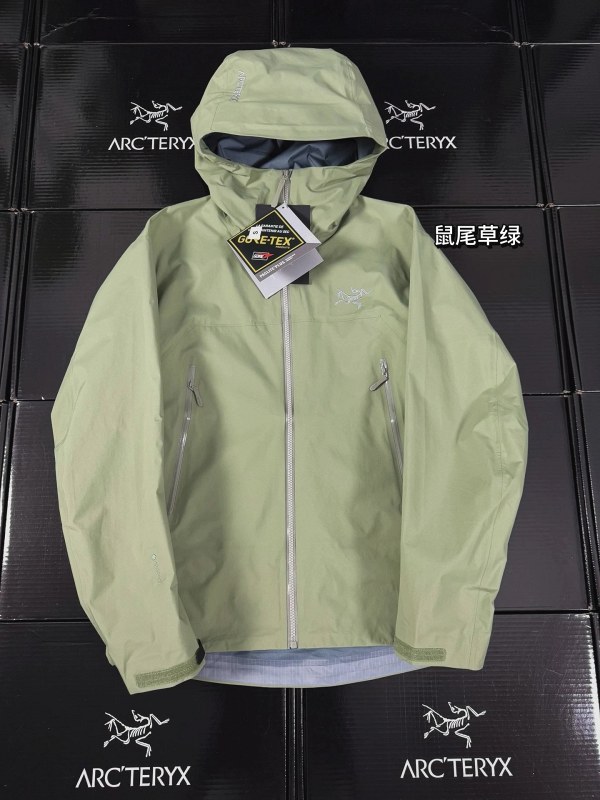
A light green hooded shell with an Arc'teryx chest logo, pit zips and a StormHood-style brim arrived at our Rotterdam test room in a plain poly mailer. We paid for it ourselves through a shopping agent, photographed the packaging before and after opening, and put it on the bench the same afternoon. Fourteen days later, after daily wear in North Sea drizzle, two heavy downpours and three wash cycles, our view is that this is a genuinely well-built jacket wrapped in a marketing sheet that contradicts itself twice.
What we ordered and what it cost
| Item | Detail |
|---|---|
| Product | Arc'teryx Green Hard-Shell Waterproof and Windproof Jacket |
| SKU | 7705102092 |
| Price paid | $141.04 (listed against an original $159.65) |
| Colour tested | Solid light green, matched hood and body |
| Size tested | M, ordered with height and weight supplied to the agent |
| Availability | In stock at the time of ordering |
The colour is the first thing to settle, because pale green is where listing photos lie most often. Placed in the daylight-balanced light box beside the listing image, our sample read slightly warmer and a touch less mint than the studio shot — closer to a soft sage. The hood, body and sleeve panels were consistent with each other, with no visible dye lot shift at the shoulder seam, which is the usual failure point on cheaper shells.
Bench measurements
Our reviews editor measured the jacket with digital calipers, weighed it on the 6 kg bench scale and inspected seams under a 10x loupe before any wear began.
| Check | Result |
|---|---|
| Weight, size M | 322 g on our scale (line-level Beta lightweight shells are reviewed at around 10.6 oz / 300 g) |
| Underarm pit zips | Two-way sliders, 30 cm opening, YKK-branded pulls |
| Main front zip | VISLON-style toothed zip with a storm flap and chin guard |
| Stitch density, main seams | 10–11 stitches per inch, even tension, no skipped stitches found under the loupe |
| Cuff closure | Velcro tab, 12 cm of adjustment per cuff |
| Pockets | Two zippered hand pockets with bonded-looking zip garages; no chest pocket on our sample |
| Hood | Fixed, single-pull rear adjuster, stiffened brim, high collar to the chin |
The seam work is the strongest part of the jacket. Tape lines sat flat at the shoulders and hood, the sleeve articulation was cut so the cuff stayed put when we reached overhead, and after three washes the taped seams showed no lifting or bubbling under the loupe. The chest logo is a multi-layer pressed application rather than a single flat transfer, and it survived all three washes without edge curl.
The spec sheet argues with itself
This is where buyers should slow down. The listing copy names N40L GORE-TEX with a tricot backer and bluesign-certified fabric in one paragraph, then names Tri-Durance waterproof fabric a few lines later. Those are two different material stories from two different product families. We can report what we observed — a three-layer-feeling laminate with a soft backer, no membrane branding visible anywhere on the garment, no GORE-TEX hangtag in the parcel — and we cannot report which of the two claims is true. A lab test would be needed and we did not commission one.
The size range has the same problem. One line advertises XS–XXL, another lists S, M, L, XL, 2XL and 3XL. The listing also asks the buyer to state height and weight at checkout, which suggests the seller is matching stock rather than running a fixed, published size chart. We supplied both figures and received a medium that matched our measurements, but a reader ordering without that step is taking a chance.
Two fabric claims, two size ranges, one garment. Treat the listing as a starting point for a conversation with the seller, not as a specification.
Fourteen days in Rotterdam weather
Our wear log records notes on days 1, 7 and 14. Day 1: worn over a merino base layer in 8 °C drizzle for two hours; shell beaded water across the shoulders, the high collar kept drips off the neck, and the pit zips vented noticeably on a fast walk to the Maas. Day 7: caught in a 25-minute heavy shower; no wet-through at the shoulders or hood brim, though the cuff on the windward arm dampened slightly where the Velcro tab gaps. Day 14: after three washes in a technical wash and a low tumble, water still beaded on the surface and the DWR had not visibly flattened.
Two smaller notes. The hood's single rear pull adjusts volume but not side-to-side vision, so a turned head drags the brim across the face — the Arc'teryx original handles this better. And the hand pockets sit high enough to clear a hip belt, which is genuinely useful, but the zip garages are stiff for the first week and need two hands to close cleanly.
Fit and layering
In community fit threads, Arc'teryx hardshell owners generally report true-to-size runs, with lighter layers often sizing down and almost nobody sizing up. Our medium matched that pattern: roomy over a base layer and a light fleece, snug over a bulky puffer at the shoulders. Sleeve length was generous by roughly 2 cm for a 180 cm frame, which is normal for a shell meant to cover a glove cuff. If you plan to layer a down mid-layer underneath, state that to the seller when ordering.
Care and the honest lifespan question
Owners and reviewers of the real Beta line are consistent on one point: a hard-used shell wears out in a few years, not a decade, and regular washing is part of ownership rather than optional maintenance. That applies here too. Ours took three washes in three weeks without complaint, and we would expect the same routine — technical wash, no softener, low heat — to keep this jacket serviceable for several seasons of city and hill use. Anyone expecting a buy-once item should look at a heavier, abrasion-focused shell instead.
Ordering through an agent
The jacket moved through a shopping agent with a QC photo set before international dispatch, which is what let us catch the colour nuance before shipping. Ask for photos of the chest logo, the inside seam tape and the size label; those three images tell you more than the listing text. Expect standard parcel timings rather than express, and budget the agent fee and line shipping on top of the $141.04 sticker.
How this scored
We scored the jacket on construction, weather performance over 14 days, fit accuracy against the size guidance we gave, and how much of the listing survived contact with the actual garment. Excellent seam work and reliable water shedding lifted it; the unresolved fabric claim and the contradictory size range held it back from the top of our scale.
Frequently asked
Should I size up in this Arc'teryx-style green shell?
No. Owners in Arc'teryx fit threads report hardshells running true to size, and our medium matched that: roomy over a base layer and light fleece, snug over a puffer. Supply your height and weight to the seller at checkout, since the listing asks for it.
Does this jacket really use N40L GORE-TEX?
We could not confirm it. The listing names N40L GORE-TEX with a tricot backer in one paragraph and Tri-Durance fabric in another, and our sample carried no membrane branding or hangtag. Ask the seller for written fabric confirmation before ordering.
How should we care for a shell like this?
Wash it regularly with a technical cleaner, skip softener and tumble on low heat. Ours took three washes in three weeks with no seam-tape lifting, and owners note that regular washing is what keeps water beading rather than an optional extra.
Community feedback (0)