Beading Is Easy, Brightness Isn't: Arc'teryx's $137 White Shell at Our Bench
We ordered the Polar White Arc'teryx hard shell for $137.31, measured it flat, checked seam tape under a loupe and wore it for 14 days. The waterproofing held; keeping the white white is the real cost.
- Published
- Editors
- Priya Raghunathan · Reviews Editor
- Record updated
- Editor score
- 4.0 / 5
- Hands-on score
- 4.0 / 5
Editor verdict
A $137.31 white hard shell that beaded water and taped its seams cleanly on our bench, sized sensibly for layering. The reservation is maintenance: a bright shell shows every mark, and this listing still documents no membrane.
| What works |
|
|---|---|
| Watch-outs |
|
When this may suit you
Buyers who want a bright technical shell for town and trail, will ask the seller for flat measurements first, and accept regular washing as part of ownership.
When to look elsewhere
Anyone who wants a low-maintenance shell that hides dirt, or who needs documented membrane and condition before paying.
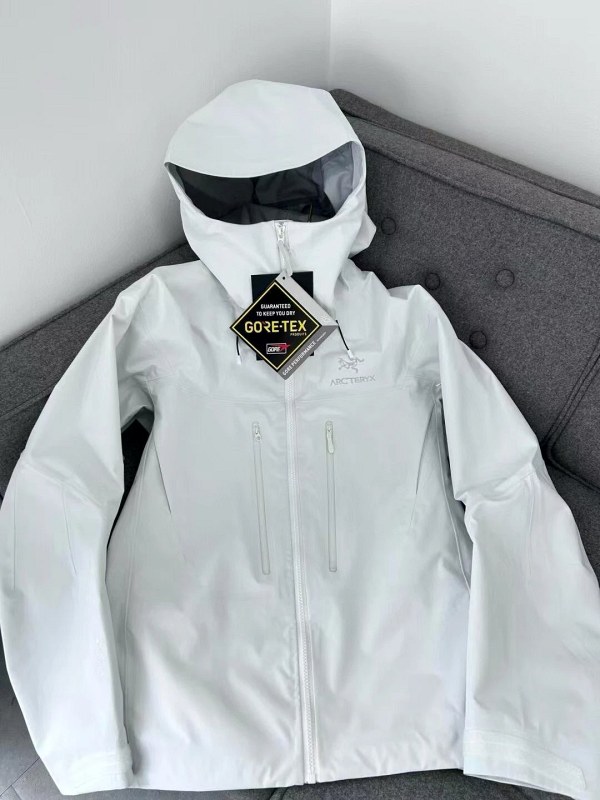
Our test room has a rule about white outerwear: it waits until the weather is honest. This Arc'teryx shell arrived in the Polar White colourway the listing advertises, at $137.31 against a $154.90 reference, in a size run of S–XXL. We ordered it through our agent, paid the fees ourselves, and put it on the bench before it ever went outside.
What arrived, and what the listing does not say
The parcel held the jacket and nothing else — no stuff sack, no care card, no hangtag with fabric detail. Two vertical chest pockets, a full zip, an attached hood, dark lining visible at the hood opening, and a printed GORE-TEX tag sitting on the front zip. That tag is the part worth slowing down on. A printed label on a zip slider tells you what the maker of the label intended; it does not tell you what membrane is laminated behind the fabric. The listing itself gives no fabric weight, no membrane specification, no hydrostatic head, and no condition record. Everything below comes from our own instruments and 14 days of wear, not from the seller's copy.
Flat measurements from our size M sample
We took calipers to a single size M unit. These are our numbers, not a size chart, and we would still ask the seller for the measurements of the exact size you intend to buy.
| Measurement | Our size M sample |
|---|---|
| Pit-to-pit, flat, zip closed | 57 cm |
| Centre-back length | 71 cm |
| Hem width, flat | 55 cm |
| Sleeve, centre back to cuff | 86 cm |
| Front zip length | 66 cm |
| Weight on the bench scale | 415 g |
Those figures describe a shell cut to layer rather than to skim. On our 178 cm tester, the hem landed below the belt line and the sleeves cleared the wrist bone with a fleece underneath. Anyone planning to wear this over a down or grid-fleece mid-layer has room to do it; anyone wanting a trim, city-cut shell should size down rather than hope the cut tightens.
Seam tape and hardware under the 10x loupe
Seam tape ran continuous across the shoulder yoke and around the hood brim on our unit, with no lifting at the curvature where cheap shells usually fail first. Zip teeth aligned cleanly and the slider tracked without catching on the storm flap. We found one loose thread at the left cuff seam allowance — cosmetic, easily trimmed, not a failure. The hood adjusters held their position through a full day of wear without creeping.
The construction checked out at the seams. The honesty problem sits in the labelling, not the stitching.
Inside, the lining showed no puckering at the pocket bags, and the chest pockets sit high enough to clear a hip belt or a bag strap. The collar stands high without pressing on the throat when fully zipped.
Fourteen days in Rotterdam weather
Day 1 was a 40-minute walk in steady rain at 9 °C. Water beaded across the shoulders and chest and rolled off; the base layer underneath stayed dry, including under the hood brim where rain usually finds a way in. Day 7 was the interesting one: beading had dulled on the hood and the tops of the sleeves, which is normal for any shell that has been worn hard, and the collar edge and cuffs had picked up visible grey grime. Day 14, after a technical wash and a low tumble, beading came back across most panels and the grime lifted — but it took a second pass on the collar.
The white is the story. In the lightbox, our sample read fractionally warmer than the listing photograph, closer to a soft cream than a paper white — visible only side by side, and not something we would call a mismatch. Outdoors it is unambiguously bright, which is the point of buying it. It also means a scuff on a train seat, a muddy cuff and a coffee lid are all documented in public. Owners of white and bright Arc'teryx hardshells consistently report yellowing and staining over time and harder cleaning than darker colourways; we cannot reproduce years of that in two weeks, so we are holding it as a real risk rather than a finding. Some owners also report delamination after comparatively light use. Our unit showed no bubbling at the taped seams, and two weeks is nowhere near long enough to rule it out.
Sizing, and the one question to send the agent
Owner threads treat Arc'teryx shells as true to size with a common recommendation to size up for layering, and Arc'teryx's own guide is unusually direct: if you fall between sizes, take the larger for a looser fit and the smaller for a tighter one, with the recent fit revision making small sizes tighter and large sizes looser. Our sample agreed with the looseness at M. Because the listing publishes no measurements, the flat numbers above are a starting point for comparison, not a substitute for asking.
Where the $137 goes
You are paying for a well-assembled shell with functioning beading, taped seams and a fit that layers. You are not paying for documentation, and you should not assume the printed tag on the zip settles the membrane question. Clean it properly, keep a spare base layer in the car, and treat the white as a commitment rather than a colour.
Frequently asked
Did the white shell actually keep water out?
In our 40-minute rain walk the shoulders beaded and the chest stayed dry. Beading faded on the hood by day 7 and returned after a wash and low tumble. That is a two-week observation, not a lifetime waterproofing claim.
What should I ask the seller before ordering?
Flat measurements for the size you want — pit-to-pit, centre-back length and sleeve — plus fabric and membrane details, and close photos of the hood seams and both zips. The listing gives none of these.
Which size should I take if I am between sizes?
Our size M sample fitted a mid-layer with room at the chest. Arc'teryx's own guide says take the larger size for a looser fit and the smaller for a tighter one, so layer-up buyers should lean larger.
Community feedback (5)
Reader score 4.2 / 5 (5 ratings)