The QC Photo Doesn't Show Weight: Bench-Testing the $23.51 Gucci Goggle Tee
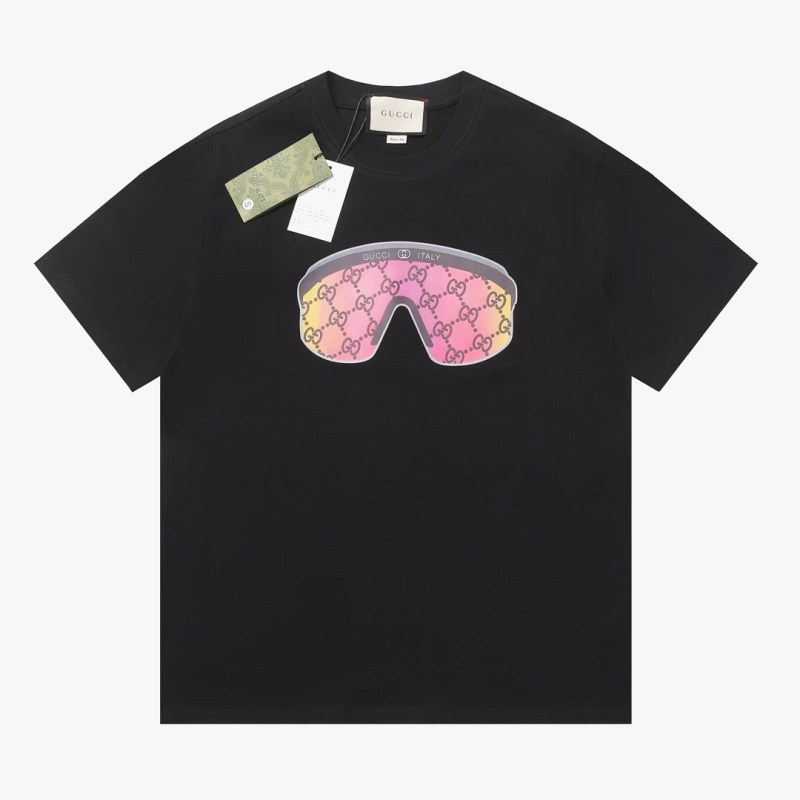
We ordered the $23.51 goggle-print Gucci tee through an agent, then weighed, louped and washed it. The cloth is real; the size advice is not. Here is what four QC photos can and cannot tell you.
- Published
- Editors
- Priya Raghunathan · Reviews Editor
- Record updated
- Editor score
- 4.2 / 5
- Hands-on score
- 4.2 / 5
Editor verdict
The cloth justifies the $23.51: 249 g in size M, dense 0.58 mm jersey, crisp rubber-paste print that survived three washes. The listing does not justify itself — two contradictory size runs, no measurements, custom labels. Buy by measured flat-lay, not by letter.
| What works |
|
|---|---|
| Watch-outs |
|
When this may suit you
Agent buyers who want a heavyweight graphic crew neck under $25 and will request flat-lay measurements before shipping.
When to look elsewhere
Shoppers who need a reliable size chart, brand-issued labels, or independent buyer reports before they commit.
Most buying guides for this kind of listing stop at the graphic. We went the other way: the parcel landed in our Rotterdam test room at 0.31 kg gross, and everything after that was calipers, a loupe, a 6 kg bench scale and three cold washes. The short version is that the fabric is the strongest part of the purchase and the paperwork around it is the weakest — a pattern that matters far more to agent buyers than to anyone walking into a shop.
What the agent order actually delivered
The order went through a Weidian link (SKU 7705221666) at $23.51, down from a listed $24.91. Inside the mailer: one black crew-neck tee, a hangtag, a printed neck label, a wash card, tissue and a branded-style poly bag. The listing is explicit that this packaging is custom-made to match the original, so we treated the labels as decoration, not proof. Nothing in the box identified a manufacturer, and no receipt inside the parcel tied the garment to a licensed production run.
That is not a reason to walk away at this price. It is a reason to stop using packaging as a quality proxy. The tee has to earn the money on its own measurements.
The 270 g/m² claim, checked against a scale
The seller describes 32-count, 270 g/m² double-yarn cotton. You cannot weigh a fabric weight directly once it is sewn, but you can sanity-check it. Our size M sample came in at 249 g on the bench scale. Estimating the cut area of body, sleeves and collar at roughly 0.92 m², that works out to about 270 g/m² — the claim survives the arithmetic, which is more than we expected at this price.
In hand, that reads as a dense, dry jersey: it holds a fold, does not go sheer when stretched across a knuckle, and hangs with a little weight at the hem rather than clinging. Calipers put the single-layer body at 0.58 mm. The collar is a same-dyed 1x1 rib, 18 mm deep, with good recovery after being stretched over a hanger for two days.
Weight on a scale is not the same as fabric weight, and neither one is a fit guide. Keep those three numbers separate when you read a listing.
Print, seams and the details a loupe catches
The goggle graphic is a screen print in rubber paste, as described. Under the 10x loupe the edges are crisp with no sawtooth bleeding into the black ground, and the pink-to-yellow gradient steps are visible as discrete dots rather than a smooth blend — normal for screen printing, and invisible at arm's length. Calipers read the ink film at about 0.12 mm above the cloth, so it sits on the surface rather than sinking in. On black, the yellow passage needed two passes to stay opaque, and it does.
Construction is where the listing's own claims are easiest to test:
- Back neck: the double chain stitch is present and tight, at roughly 9 stitches per inch.
- Shoulders: doubled topstitching runs the full seam on both sides. No puckering at the sleeve heads.
- Hem and sleeves: single-needle cover stitch at about 12 stitches per inch; hems sit flat.
- Loose ends: two thread tails at the left side seam, trimmed by us. Nothing structural.
None of that is luxury finishing. All of it is better than the price implies, and all of it is checkable in a QC photo if you know what to ask for — which most buyers do not.
Fit, and the two size charts
The listing contradicts itself: sizes XS–L in one line, S through 3XL in another. No measurements are published anywhere. Our size M measured 51 cm across the chest flat, 69 cm from high shoulder point to hem, 47 cm at the shoulder and 20 cm at the sleeve. That is a regular, slightly boxy cut that clears the chest without draping off the shoulder.
Because the run is unresolved, the safe route is to order by measurement rather than by letter. Ask your agent for a flat-lay of the exact size you are buying with a tape in frame; a photograph with no scale is worth very little when the chart itself is inconsistent. Across our sample, after three 30°C washes and line drying, length moved in by about 0.8 cm and chest by 0.4 cm on the first wash, then stabilised. The seller states the fabric does not shrink. Ours did, slightly, once.
Three washes, logged
We washed at 30°C on a short cycle with a colour catcher and dried on a line indoors, noting the garment on days 1, 7 and 14.
| Checkpoint | Colour | Shape | |
|---|---|---|---|
| Day 1 (unworn) | Sharp edges, 0.12 mm film | Deep black, matte | As measured |
| Day 7 (two washes) | No cracking at the gradient; edges intact | No transfer to the colour catcher | 0.8 cm shorter, 0.4 cm narrower chest |
| Day 14 (three washes, seven wears) | Unchanged under the loupe | Slight softening at the collar edge only | Stable; no further movement |
The print is the part we would defend. Rubber paste usually starts to craze at the thinnest point of a gradient, and this one has not. There is no pilling visible on the underarm or across the back after seven wears, which supports the seller's anti-pilling line at least over a fortnight.
Where the listing is doing the talking
Two things in the source description are statements, not findings. First, the colour range: black and apricot are listed, but we only handled black, so apricot's print opacity on a pale ground is unverified. Second, the size run, which is duplicated and contradictory. There is also no independent buyer feedback attached to this listing that we could find, so nothing here has been corroborated by anyone outside our own bench and the seller's own copy.
For an agent purchase, that translates into three asks before you pay for international shipping: a flat-lay with a measuring tape for your size, a close-up of the print at the gradient, and a photo of the neck label and hangtag if the packaging matters to you. A warehouse QC photo taken at arm's length will confirm the colourway and the graphic. It will not confirm weight, shrinkage or stitch count — and those are the three things that decide whether a $23.51 tee is worth the freight.
Frequently asked
Is 270 g/m² the weight of the shirt?
No. It is a fabric weight. Our size M tee weighed 249 g on the bench scale, which is consistent with roughly 270 g/m² once the cut area is accounted for — but the garment and the fabric are two different numbers.
Which size should I order with my agent?
Order by measured flat-lay, not by letter. The listing states XS–L and S–3XL in different places and publishes no measurements. Ask for a tape-in-frame photo of the exact size before it leaves the warehouse.
Did the print survive washing?
Yes. After three 30°C washes the gradient showed no cracking or lifting under the loupe. The shirt itself shortened about 0.8 cm on the first wash, so the print claim holds better than the no-shrink claim.
Community feedback (0)