Onitsuka Tiger Mexico 66 Yellow Review: Calipers, a Loupe and a Mismatched Style Code
We paid $34.48 for the yellow Mexico 66, measured it with calipers and wore it for 14 days. The shoe is light and easy on the foot; the style code on the listing belongs to a Serrano.
- Published
- Editors
- Priya Raghunathan · Reviews Editor
- Record updated
- Editor score
- 4.0 / 5
- Hands-on score
- 4.0 / 5
Editor verdict
A light, tidy retro sneaker for $34.48, held back by paperwork: the listing's style code and spec sheet describe a Serrano, and the outsole is weak on wet ground.
| What works |
|
|---|---|
| Watch-outs |
|
When this may suit you
Buyers who want the yellow Mexico 66 look for under $40, will wear it in dry weather and can confirm the model with their agent before shipping.
When to look elsewhere
Skip if you need reliable wet-weather grip, want the exact model named in the title without doubt, or need strong long-term construction evidence before spending.
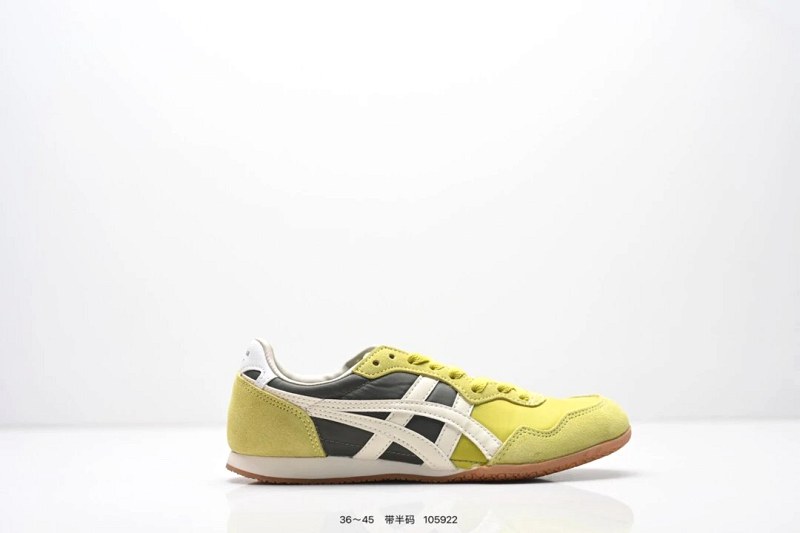
The yellow Onitsuka Tiger Mexico 66 is one of those sneakers that photographs well from any angle: low profile, black Tiger Stripes, white trim, a slightly upturned toe. At $34.48 on an agent listing — down from a stated $40.95 — it is also one of the cheapest ways to get that silhouette onto your feet. We ordered a pair through our shopping agent, paid the fees ourselves, filmed the unboxing in the Rotterdam test room and put the shoes through our standard bench routine before wearing them daily for 14 days.
The short version: the shoe we received is light, comfortable for casual wear and visually close to the listing photos. The paperwork is the problem. The style code printed in the listing, 1183B400-407, does not belong to a yellow Mexico 66.
What we ordered and what arrived
The order was placed against SKU 7702253671 at $34.48, in the size range the listing advertises (EU 36–45, half sizes included). The listing describes a leather-and-synthetic upper with a leather lining, a thin sole and a rubber outsole, and names the model as the Mexico 66. What landed was a single boxed pair, no dust bag, no spare laces, with a woven tongue label and a printed size tag. Our sample was an EU 42.
The description and the specification text filed under the same listing do not agree with each other. The description says sizes 36 to 45; the specification block lists a run starting at 35. The description calls the shoe a Mexico 66; the specification block describes the SERRANO™, names Madrid's Serrano street, and lists a breathable leather-and-synthetic upper, a leather lining, a SOLYTE and EVA midsole and a rubber outsole — then warns that buyers have reported the outsole is not very slip-resistant in rain. That warning is worth keeping; more on it below.
Bench numbers for our EU 42 sample
| Check | Measured | Note |
|---|---|---|
| Single shoe weight | 287 g | Bench scale, no box or paper |
| Insole length | 272 mm | Calipers, heel to toe inside the collar |
| Heel stack | 21 mm | Includes outsole; forefoot 10 mm |
| Stitch density | 8 stitches per 25 mm | 10x loupe, Tiger Stripe panel edges |
| Toe spring | Visible, moderate | Front lifts roughly 12 mm off the bench |
| Boxed pair, as received | 0.76 kg | Relevant if you consolidate |
Under the loupe the stitching was tidy, evenly tensioned and trimmed, with one skipped stitch on the left eyestay that has not moved in two weeks. The eyelets are metal and seated flat. Panel joins along the toe bumper are straight and the yellow dye is consistent between the quarter and the toe box. In the light box the yellow read very slightly warmer than the listing photo — the sort of difference you would never notice without them side by side.
The style code is the real story
Article 1183B400-407 is a Serrano code, not a Mexico 66 code. Public product records tie that number to a Serrano in a white and blue colourway, and Onitsuka Tiger's own Serrano page describes the model as a 1970s track-spike-inspired runner with a thin outsole and a slightly upturned forefoot — which is exactly the language pasted into this listing's specification block. The Serrano's official material line is nylon with cow and goat suede, plus synthetic leather; that does not match the listing's leather-and-synthetic upper with leather lining either.
Two catalogues have been stapled together here: Mexico 66 photography and title on one side, Serrano article code, copy and materials on the other. We cannot tell you which one the warehouse will pull.
That does not automatically make the pair bad value — ours was well put together for the money — but it does mean the specification you read is not a reliable description of the shoe you will get. Treat the model name, the article code and the material list as claims to confirm, not facts to rely on.
Fit and how it feels
Our EU 42 measured 272 mm of insole, which sat where we expected for that size rather than obviously long. The published buyer evidence points the other way: one Zappos reviewer found the Mexico 66 roomy and went a half size down for what they called a really nice fit. That is a single report, so we would not size down blind — especially with a $34 pair where a return means shipping a box back through an agent. Order the size you normally wear and only adjust if you have the option to exchange.
The interior is soft and low-volume, the heel counter is unstructured, and there is no arch support to speak of. The shoe weighed 287 g on our scale, which is why it disappears on foot. A wearer on Threads reported that roughly 25,000 steps a day in Tokyo left their feet without soreness, crediting a surprisingly soft sole; our experience is milder — comfortable for a few hours of walking, less so for a full day on hard pavement.
Fourteen days on Rotterdam pavement
Day 1
No break-in period. The toe box is shallow, so thin socks are the sensible pairing. Heel hold was secure with the laces pulled normally.
Day 7
Toe-crease creasing appeared on the left shoe, as expected on a leather-and-synthetic upper. No colour transfer onto white socks and no dye rub onto light trousers. The outsole showed light scuffing on the heel edge with the tread pattern fully intact.
Day 14
The outsole is the weak point. On wet paving and on smooth tile indoors, grip is noticeably worse than on any modern rubber compound, which lines up with the listing's own caveat that buyers report poor slip resistance in rain. Keep these for dry days. Stitching, eyelets and panel bonds held up; no separation at the toe bumper or the heel.
We also note the one durability report in the record: a buyer who purchased a Mexico 66 from the official Onitsuka Tiger store in Harajuku reported serious quality problems after roughly two to three weeks of wear. It is a single account, and it concerns a retail pair rather than an agent order, but it is the only long-term construction report we found. Fourteen days of our own wear did not reproduce it.
Buying this pair through an agent
At $34.48 against roughly €130 / $150 official retail, the value case rests on accepting uncertainty about the model. Reduce that uncertainty before the parcel leaves the warehouse: ask for QC photos of the tongue label, the printed size tag and the box label, and request the article code in writing. If the code comes back as 1183B400-407, you are almost certainly being sent a Serrano, whatever the listing title says. That is not a reason to cancel — it is a reason to know.
The pair is light enough that a single-shoe order rarely justifies its own shipping line; our boxed pair came in at 0.76 kg, so it consolidates well with clothing or a second pair. Request the box be packed flat or reinforced, since the thin cardboard arrived dented on one corner but protected the shoes.
What would change our assessment
If the seller clarifies the model and the article code, this becomes a straightforward budget retro runner and the paperwork caveat falls away. If the outsole compound were updated for wet grip, the score would rise. Our pair scored well on build tidiness and comfort for the price, and lost ground on documented ambiguity and wet-weather traction. We will retest after any listing change to the article code or material specification, and we keep the receipt, the box label photo and the bench sheet on file.
Frequently asked
What should I ask my agent to photograph before shipping?
Ask for the woven tongue label, the printed size tag and the box label, and request the article code in writing. Those three photos tell you whether you are receiving a Mexico 66 or a Serrano before the parcel leaves the warehouse.
How heavy is the parcel for consolidation purposes?
Our EU 42 pair weighed 0.76 kg boxed on the bench scale, with each shoe at 287 g. That makes it an easy add-on to an existing consolidation rather than a shipment worth opening on its own.
Did the shoebox survive shipping?
It arrived with one dented corner and no crush damage to the shoes inside. The cardboard is thin, so if you are consolidating several pairs, ask for the box to be reinforced or packed flat.
Community feedback (0)