thom browne Jacket Fall/Winter: Consolidate or Split?
This article addresses a specific shipping question: when the [Thom Browne](https://fashion-reps.net/brand/thom-browne) jacket on a [Fashionreps](https://fashion-reps.net/) product page has entered a pending shipment or QC stage, and you also have other packages to process, should you consolidate shipping, or let the jacket go out alone? After reading, you should be able to do three things: confirm the current product and package information, compare the two options based on actual billing condi
- Published
- Editors
- Nathaniel Brooks · Editor-in-Chief and Founder
- Record updated
- Editor score
- 4.2 / 5
This article addresses a specific shipping question: when the Thom Browne jacket on a Fashionreps product page has entered a pending shipment or QC stage, and you also have other packages to process, should you consolidate shipping, or let the jacket go out alone?
After reading, you should be able to do three things: confirm the current product and package information, compare the two options based on actual billing conditions, and pause numerical judgments when key data is missing. This article does not apply to situations where payment has been completed, line restrictions explicitly prohibit consolidation, or the destination country has import restrictions on the relevant goods. 📦
The verification date for this record is 2026-10-11. Since the current records do not provide real-time product prices, warehouse-measured weights, package dimensions, destination, line quotes, or exchange rates, no unverified specific amounts are output.

What This thom browne Jacket Shipping Decision Solves
Consolidating is not inherently cheaper, and splitting is not necessarily safer. What usually determines the outcome is not the product price of the jacket itself, but the billable weight after packaging, volumetric weight, line starting price, number of packages, packaging service fees, payment fees, destination country taxes, and after-sales handling costs.
For fall/winter jackets, filling, hangers, outer packaging, and crush-proof requirements can all change package volume. If you add shoes, pants, or other bulky items, consolidation may trigger a higher volumetric weight tier. Conversely, if each package is already near the line's first weight bracket, consolidation has the opportunity to reduce duplicate fixed fees, but this must be verified with an official calculator or warehouse quote. 🧥
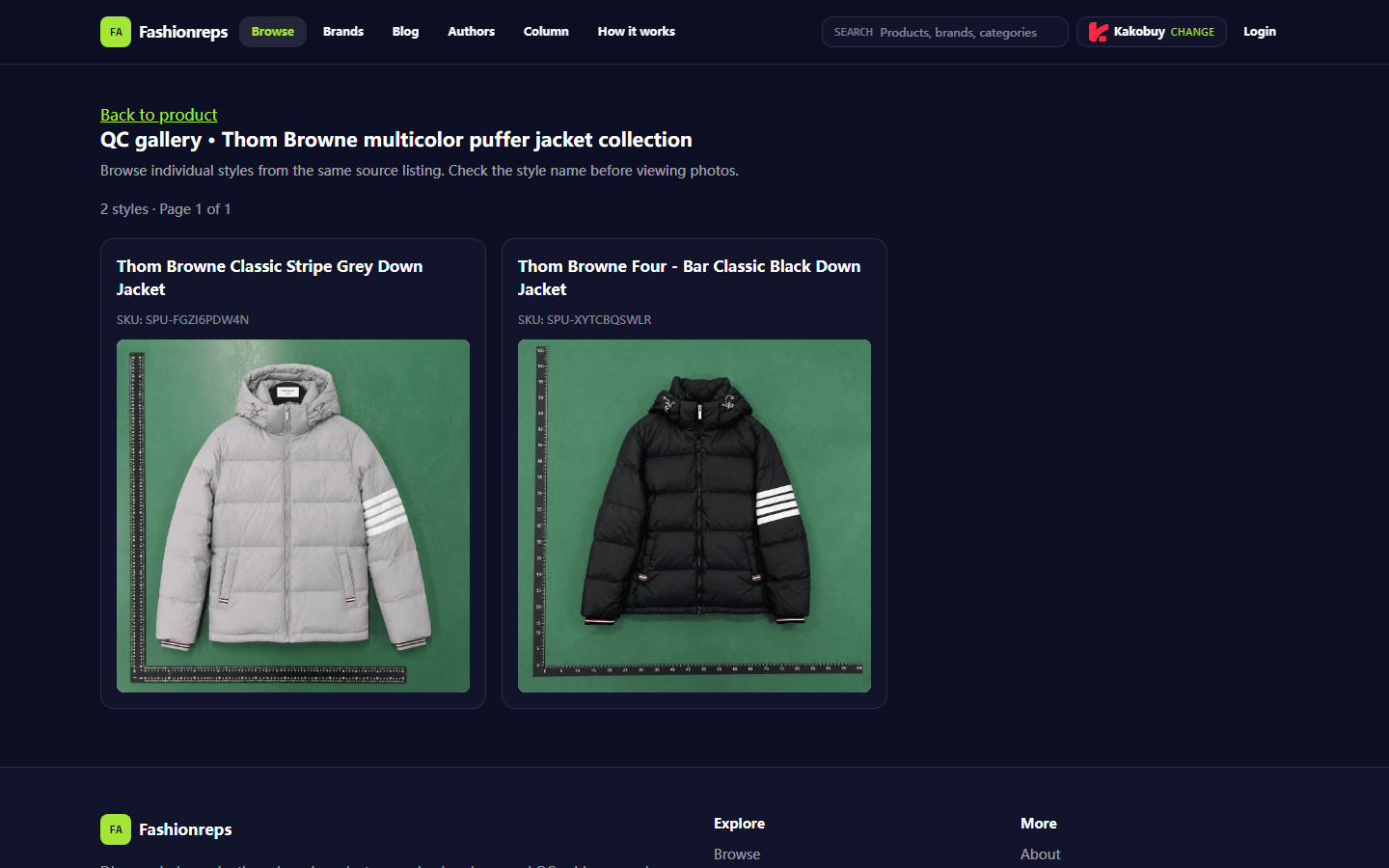
The subject of this judgment is the Thom Browne multicolor puffer jacket collection shown on the Fashionreps product page and its QC gallery. The gallery lists two styles: Thom Browne Classic Stripe Grey Down Jacket, SKU SPU-FGZI6PDW4N; Thom Browne Four-Bar Classic Black Down Jacket, SKU SPU-XYTCBQSWLR. They belong to the same source product collection but are different styles; you cannot treat two products as identical just based on the collection name.
Verify Style, Color, Size, and Current Link from the Fashionreps Product Page
Before shipping, go back to the Fashionreps product page rather than relying on order abbreviations or favorites. Record item by item:
- The product name and style name currently displayed on the product page.
- Whether the color, size, and SKU match your order records.
- Whether the product page still opens normally and contains clear product information.
- Whether the current page has entered the QC gallery, and which style the photos correspond to.
- Whether the product you are about to ship is the same as what is shown on the current page, not another style from the same source.
QC photos can only help you verify visible appearance, size markings, color, and packaging condition; they cannot prove filling composition, warmth, brand authenticity, wearing effect, or after-sales results. Do not write about flatness, puffiness, or creases seen in photos as if you have touched or tried them on.
Fashionreps is a product discovery, independent verification, and shopping agent comparison entry. Orders, payment, warehousing, international shipping, and after-sales are typically handled by the external shopping agent website you choose, so final costs and available lines should be based on the agent's backend and its official calculator. 🔎
First Record Package Count, Packaging Status, Destination, and Visible Weight Information
Before comparing consolidation and splitting, create a pre-shipment record. Save at least the following:
- The number of packages currently in the warehouse.
- The product and order number corresponding to each package; cover personal information when sharing screenshots externally.
- Whether each package has completed QC, repackaging, or removal of original packaging.
- The actual weight, dimensions, billable weight, or other visible weight fields shown on the warehouse page.
- Destination country/region, postal code, and address information that may affect the line.
- The planned shipping line, currency, and query time.
- Any batteries, liquids, magnetic items, brand restrictions, or other line prohibition factors.
If you only see the product name without package dimensions and weight, you cannot reliably judge the billable weight after consolidation. If you only see an estimated shipping cost without the line, destination, and timestamp used by the calculator, you cannot treat that result as a final quote.
What Billing Conditions to Check for Consolidation and Splitting
Consolidation suits cases where fixed fees for multiple packages are high, the line allows merging, there is no significant volumetric weight penalty after merging, and you can accept the risk of loss concentrated in one shipment.
Splitting suits cases where the jacket is bulky, other items would significantly increase volumetric weight, different items require different lines, or the destination country has stricter restrictions on package value and category. Splitting may allow some items to arrive earlier but usually increases duplicate first weight, handling fees, or payment fees.
| Check Item | Consolidation Focus | Splitting Focus |
|---|---|---|
| Billable weight | Rules for actual vs volumetric weight after merge | Which billable weight applies to each package separately |
| Fixed fees | Whether duplicate starting fees, handling fees, or packaging fees are reduced | Whether fees are duplicated due to more packages |
| Line restrictions | Whether merged category, value, and dimensions are accepted by the line | Whether each package can choose a more suitable line |
| Risk distribution | One shipment loss or delay may affect more items | Risk spread, but need to manage multiple tracking numbers |
| Customs and taxes | Total declaration, package value and category processed together | Each package declared separately, not to evade regulations |
Do not split orders, under-declare, falsely declare, or deliberately hide product information to reduce costs. Destination country taxes, import restrictions, and declaration requirements should be handled truthfully. 🛃
How to Separate Product, Service, Payment, Packaging, and International Shipping Fees
When comparing, don't just look at international shipping. It's recommended to divide costs into five columns:
- Product fee: the actual order amount of the jacket and other items in the same package.
- Service fee: shopping agent purchasing, warehousing, QC, consolidation, or other clearly listed service fees.
- Payment fee: handling fees, exchange rate differences, or top-up costs shown by the payment channel or agent platform.
- Packaging fee: repackaging, reinforcement, shoebox removal, or other optional packaging service fees.
- International shipping fee: shipping cost calculated by destination, line, billable weight, and dimensions.
If the platform combines multiple fees, save a fee breakdown screenshot or order details; do not average the total across items. In particular, packaging fees and consolidation handling fees may occur only at a certain step and cannot be double-counted.
Exchange rates must also be recorded separately. When comparing in USD, RMB, or other currencies, note the conversion time and rate source; payment, refund, and bank posting rates at different times may differ. 💳
How to Save Billable Weight, Line, Taxes, and Timestamps from Official Calculator Results
Open the official shipping calculator of the shopping agent you actually use, enter destination, number of packages, product category, and the weight and dimensions required by the page. When saving results, at least retain:
- Query date and exact time.
- Destination country/region and postal code.
- Selected shipping line.
- Actual weight, volume dimensions, and billable weight used by the calculator.
- Shipping cost currency and amount displayed.
- Whether fuel surcharges, insurance, taxes, or other surcharges are included.
- Estimated transit time and its applicable conditions.
- Whether the calculator indicates manual review, line restrictions, or final weight subject to warehouse reweighing.
Calculator quotes are not permanent. Warehouse reweighing, repackaging, fuel surcharges, exchange rate changes, line adjustments, and destination charges may change the final amount. If the calculator gives a range, the article or decision record should keep the range, not arbitrarily write a fixed value. ⏱️
How to Stop Numerical Judgment When Dimensions, Weight, or Real-Time Rates Are Missing
If any of the following occurs, pause the conclusion of "consolidation is cheaper" or "splitting is better":
- Only the product page, no warehouse measured data.
- Only total weight, no dimensions, cannot judge volumetric weight.
- No clear destination or postal code.
- Line quote is outdated, or no query time shown.
- Fee page does not state whether packaging, insurance, and taxes are included.
- Merged product category may trigger line restrictions, but agent has not confirmed.
- Jacket has not completed QC, and packaging condition may change.
What you can do at this point is organize pending confirmation fields rather than filling in guessed amounts. When contacting agent customer service or warehouse, prioritize asking about estimated dimensions after consolidation, billable weight rules, available lines, additional packaging fees, insurance options, and final reweighing mechanism.
If you only have the product page and QC images, at this stage you can at most complete product identity and appearance records; you cannot conclude on consolidation vs splitting costs.
Final Actions: Complete the thom browne Jacket Pre-Shipment Consolidation Checklist
Before shipping, follow this order:
- Open the Fashionreps product page, confirm style, color, size, SKU, and current QC gallery.
- In the warehouse backend, record package count, item correspondence, packaging status, actual weight, and dimensions one by one.
- Confirm destination, postal code, currency, and shipping line.
- Record product fee, service fee, payment fee, packaging fee, and international shipping fee separately.
- Use the official calculator to simulate consolidation and splitting separately, and save query timestamps.
- Check line restrictions, truthful declaration requirements, tax explanations, and insurance conditions.
- Compare total cost, waiting time, tracking management burden, and concentrated loss risk of the two options.
- Make the final choice only when key fields are complete and quote conditions are consistent.
Final conclusions cannot be divorced from sample data. Consolidation may save duplicate first weight, handling, or packaging costs, but may also increase fees and risks due to volumetric weight, concentrated package value, or route restrictions. Splitting may increase fixed fees and tracking management work, but is more appropriate when the jacket is bulky, line restrictions differ, or you want to spread shipping risks.
Therefore, the person suited to consolidation is someone who has obtained measured data for each package, the line after merging is clearly available, and can accept the risk concentrated in one shipment. The person suited to splitting is someone whose consolidation would significantly increase billable weight, different items require different lines, or who wants to spread shipping risks. If dimensions, weight, destination, or real-time rates are missing, it is not recommended to judge solely based on product name, QC images, or experience, nor to make false declarations to save money.
Frequently Asked Questions for Agent Platform Shopping
1. How to evaluate the quality of a product on mulebuyus.com?
To judge product quality, it is recommended to look at QC photos rather than relying solely on factory-provided images, as factory photos are usually retouched. You can use QC photos to verify whether the product details meet your specific requirements before deciding to purchase.
Also, avoid products with extremely low prices, as they usually have poor quality.
2. How to view QC photos on mulebuyus.com?
When viewing QC photos, focus on the specific parts of the purchased product. For example, for shoes, check several key areas—such as the toe, heel, and tongue—to verify stitching, shoe construction, and tongue thickness to determine if it is a high-quality product. For clothing, check details like collar tags, logo embroidery, fabric, and the flatness of collars and cuffs.
3. Why doesn't mulebuyus.com use Google Sheets?
Google Sheets is only suitable for tables with a small number of products. Once the product count increases, loading becomes very slow and the system lags noticeably. Especially on mobile devices, the visual experience is poor and searching for products is extremely inconvenient. For the same set of products, the mulebuyus.com website's table loads faster and offers a better visual experience.
4. Is the spreadsheet website of mulebuyus.com safe?
mulebuyus.com does not collect any personal information; it only serves as a product catalog for the agent platform. All transactions are completed on the agent platform.
Community feedback (0)