Versace Accessories Cost Check Before Ordering
## Defining the Cost Verification Task for Versace Fall/Winter Accessories Before placing an order, what you really need to confirm is not just the dollar price shown on the product page, but the projected total cost formed by the product price, possible discounts, service fees, payment fees, packaging and handling fees, international shipping, destination taxes, and currency conversion. This article focuses on one task: after viewing Versace [accessories](https://fashion-reps.net/accessories) o
- Published
- Editors
- Nathaniel Brooks · Editor-in-Chief and Founder
- Record updated
- Editor score
- 4.2 / 5
Defining the Cost Verification Task for Versace Fall/Winter Accessories
Before placing an order, what you really need to confirm is not just the dollar price shown on the product page, but the projected total cost formed by the product price, possible discounts, service fees, payment fees, packaging and handling fees, international shipping, destination taxes, and currency conversion. This article focuses on one task: after viewing Versace accessories on fashion-reps, establishing a reviewable pre-order cost record.
This method is suitable for buyers who are ready to purchase Versace accessories such as sunglasses but have not yet confirmed the final package plan. It does not apply to orders that have already generated a complete shipping quote or require handling returns, after-sales disputes, and customs declarations. Prices, inventory, service fees, routes, taxes, and page status may change, so re-verify before ordering. 🧾
Pin Down the Product, Specs, and Price from the Live fashion-reps Page
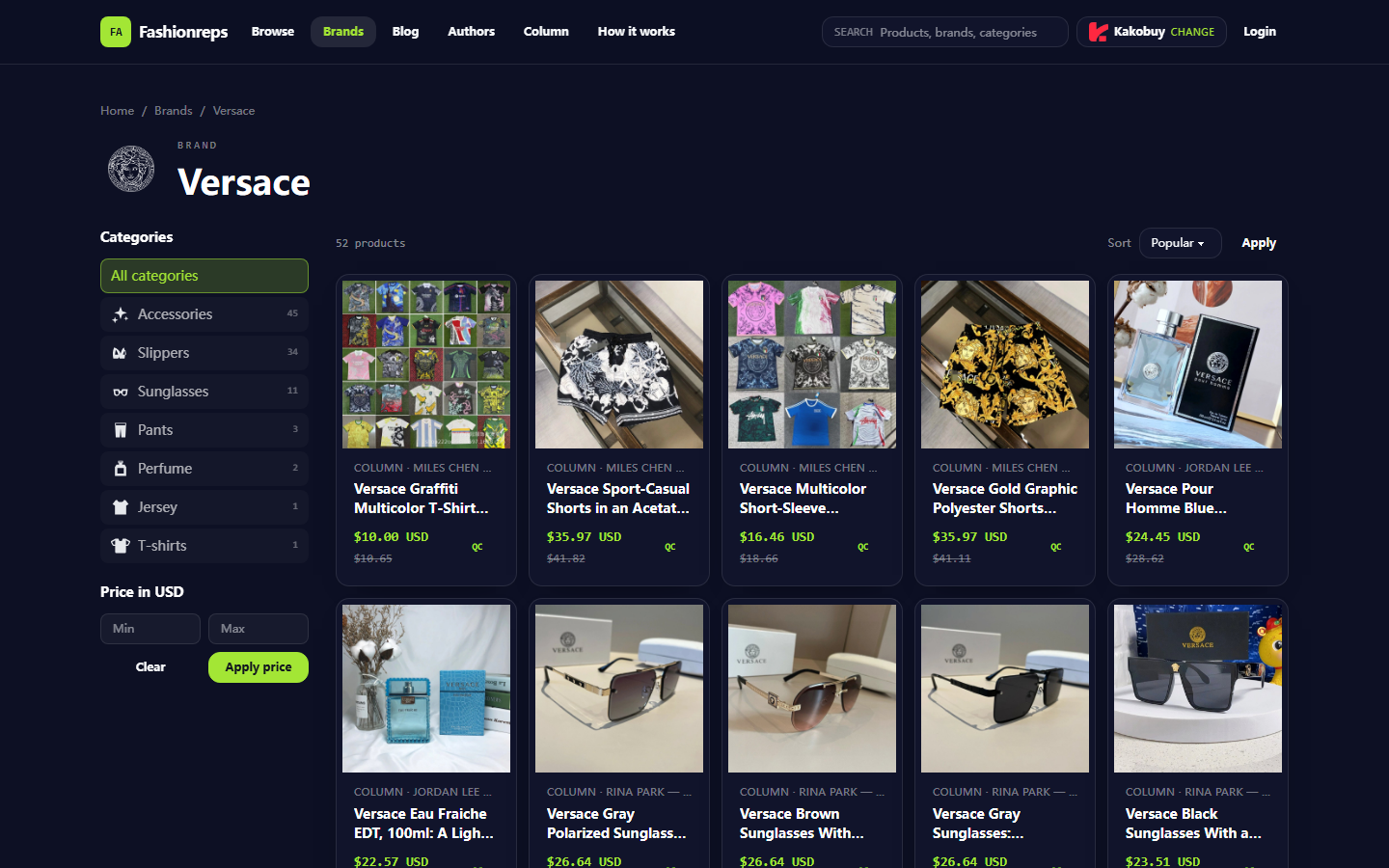
First, identify the specific product in the Versace brand catalog, rather than just recording the category name "Versace sunglasses." Page data shows that the brand catalog contained 52 items at that time, with the Accessories category showing 45 items and the Sunglasses category showing 11 items. The product names, color descriptions, and reference prices in the catalog should be saved together to avoid mistaking different styles for the same product later.
In the provided catalog samples, some sunglasses reference prices are as follows:
| Product Record | Reference Price Shown on Page | Content to Verify Further |
|---|---|---|
| Versace Gray Polarized Sunglasses in a Large Everyday Frame | 26.64 USD | Inventory, lens info, specific specs, purchase link status |
| Versace Brown Sunglasses With Polarized Lenses in a Modern Everyday Shape | 26.64 USD | Whether brown version is still purchasable, specs and page status |
| Versace Black Sunglasses with a One-Piece Oversized Sport Frame | 23.51 USD | Size, inventory, actual available options |
| Versace Gray Polarized Sunglasses With Chain-Link Temple Detail | 28.21 USD | Detail version, inventory, and available purchase entry |
These are reference prices from the page data, not locked checkout prices, and they cannot alone prove the existence of available discounts. The page also showed a higher previous reference price at some point, but without clear discount conditions, validity period, and checkout page confirmation, the difference should not be treated as a confirmed savings amount.
The product record should at least include the full product name, color or style, page reference price, currency, page screenshot or saved record, verification time, and target purchasing platform. Do not save only the brand name or a blurry screenshot. 📌

Check Service Fees, Payment Fees, and Exchange Rate Sources
The purchase process description on fashion-reps shows that the Buy button leads to the selected shopping agent. After selecting an agent, cost verification should be completed in that agent's actual quote page or checkout process. Different agents, payment methods, and order statuses may correspond to different fees, so you cannot apply one platform's service fees to another.
It is recommended to break down fees into the following items:
- Product amount: Record the specific product quantity multiplied by the page-confirmed unit price.
- Agent service fee: Only fill in a confirmed value when the target agent clearly displays the rate, calculation method, or checkout amount.
- Payment fee: Record whether the payment method incurs fixed fees, percentage fees, or exchange surcharges; if there is no page basis, keep it as "to be queried."
- Exchange rate conversion: Note the exchange rate source, query time, original currency, and settlement currency. Do not mix bank card posting exchange rates, platform display exchange rates, and search engine mid-market rates.
- Discounts: Record the applicable threshold, applicable products, validity period, and whether it can be combined with service fees.
You can use the following calculation formulas to organize a draft:
Product subtotal = Unit price × Quantity
Estimated agent-side subtotal = Product subtotal + Confirmed service fee + Confirmed payment fee + Confirmed packaging fee
Estimated delivered cost = Estimated agent-side subtotal + Confirmed international shipping + Confirmed destination taxes
When an item does not have a verifiable value, write "To be queried" instead of filling in zero. Zero means confirmed no fee, while "to be queried" means fee status not yet determined; the two cannot be used interchangeably. 💱
Unify Package Quantity, Packaging, Destination, and Billing Conditions
Package cost cannot be judged independently of order conditions. At minimum, fix the product quantity, whether to keep original packaging, whether to consolidate packages, destination country or region, zip code, estimated package weight, estimated volume, and any special route restrictions.
For accessories like sunglasses that are easily crushed, packaging method affects volume, protection, and chargeable weight. Keeping the original box may increase volume, removing outer packaging may reduce volume but may also change protection conditions. Unless the agent clearly explains the handling results and scope of responsibility, do not assume that removing packaging is always cheaper, nor that consolidating packages is always better than splitting them.
Consolidated and split shipments should be recorded separately:
- Consolidation may reduce repeated first weight or some operational costs, but may increase volumetric weight, package declared value, and single-loss risk.
- Splitting may incur more fixed fees, but may be easier to arrange when there are route restrictions, package size limits, or higher single-package risk.
- Only when product quantity, packaging plan, destination, and billing rules are consistent are the amounts of two plans comparable.
If you only have a single item's reference price and no actual weighing and route quote, you can only complete product-side cost verification and cannot infer the final package cost. 📦
Break Down International Shipping Costs Using Verifiable Logistics Pages
International shipping should be based on the available route quotes provided by the target agent. When verifying, do not just record "shipping roughly how much"; instead, save the route name, destination, chargeable weight or volume, first weight and additional weight rules, surcharges, prohibited and restricted items, and quote validity time.
For Versace sunglasses, it is recommended to compare routes after obtaining warehouse weighing or estimated package information. Based solely on the product page price, you cannot judge international shipping; based solely on the product name, you cannot confirm whether the package has special packaging or shipping restrictions.
Shipping cost records can be broken down into:
- Base shipping: The amount shown for the route at the current destination and chargeable weight.
- Fuel, remote area, or other surcharges: Only include if explicitly listed on the page or quote.
- Packaging or reinforcement fees: Record whether charged separately by the agent.
- Insurance or compensation options: Record whether voluntarily selected, scope of application, and limitations.
- Destination taxes and customs clearance fees: Unless clearly included in the quote, mark separately as "to be confirmed."
Do not write the agent-side estimated shipping as a guaranteed price, and do not include taxes in the shipping cost and then double-count them. Customs clearance and taxes should be handled according to applicable destination regulations, and should not be reduced in apparent cost through under-declaration, order splitting to avoid taxes, or evading inspection. ✈️
Distinguish Confirmed Fees, Fees to Query, and Non-Inferable Items
Before ordering, information can be divided into three layers. The first layer is fees clearly shown on the page or quote and corresponding to the current product and order conditions; the second layer is fees that you know need to be queried but have not yet obtained a quote for the current order; the third layer is items that cannot be inferred from existing data alone.
Confirmed fees can enter the estimated subtotal. Fees to query must retain the item name and query entry. Non-inferable items cannot be filled in using historical orders, other agents, or other countries' experience.
The data available this time mainly supports verification of the Versace brand catalog, some sunglasses' product names, style descriptions, and reference prices, as well as the agent selection method in the purchase process. The existing data does not provide service fees, payment fees, packaging fees, international shipping, taxes, inventory, or final checkout amounts for the current order. Therefore, these items cannot be written as confirmed values.
This distinction is important: product page prices can help filter styles, but cannot alone answer "how much will I ultimately pay." Only by putting product, agent, packaging, destination, and route conditions in the same record does cost comparison become meaningful. ✅
Record Page Time, Currency, and Calculation Basis
Every verification should leave a timestamp and basis. At minimum record:
- Page verification date and time.
- Product name, style, color, and quantity.
- Page display currency; this sample is USD.
- Whether the price is a current reference price, historical reference price, or checkout price.
- Target agent name.
- Destination country or region and zip code.
- Packaging, consolidation or split assumptions.
- Exchange rate source, query time, and conversion direction.
- Confirmation status of service fee, payment fee, shipping, and taxes.
If the product name, price, inventory, or purchase entry changes after reopening the page, use the latest verification result and keep the old record to explain the change. Do not use old screenshots to prove current availability, and do not put prices from different times directly into the same formula.
Checklist for Proceeding, Supplementing, or Postponing After Verification
Situations where you can proceed to next steps: product name and style are fixed, page reference price and currency are recorded, target agent is selected, destination and packaging conditions are clear, and the agent side has provided reviewable fees or quotes.
Situations requiring supplementation: product page has only vague name, price has no currency, discount lacks applicable conditions, service fee or payment fee has no calculation basis, packaging plan not confirmed, or shipping has only verbal estimate. In these cases, supplement with page records, agent quotes, weight information, or exchange rate basis.
Situations suggesting postponement: product link cannot be opened normally, page only has tags or blank content, inventory status unknown, checkout price cannot be matched with catalog price, agent fees have no traceable record, destination taxes have major uncertainty, or compliance issues are involved to reduce costs.
The current data can only confirm some Versace accessories' catalog reference prices and cannot calculate a reliable final savings amount. A lower product reference price may reduce the product subtotal, but service fees, packaging, shipping, exchange rate changes, and taxes may still increase total expenditure; consolidation may reduce repeated handling costs, but may also increase volumetric weight and single-package risk. This method suits buyers willing to save evidence item by item and wait for warehouse and route information; it is not suitable for buyers who need a fixed delivered price, immediate inventory guarantee, or no further verification.
Community feedback (0)